
What This Page Covers
This page explains how Right of First Refusal (ROFR) clauses function in real-world real estate transactions and why they often introduce timeline risk, buyer friction, and execution complexity.
The focus is not the legal definition of ROFR, but how it actually affects closings in Northern Michigan HOA-controlled subdivisions.
Core Framework: Execution Gap Risk
Definition:
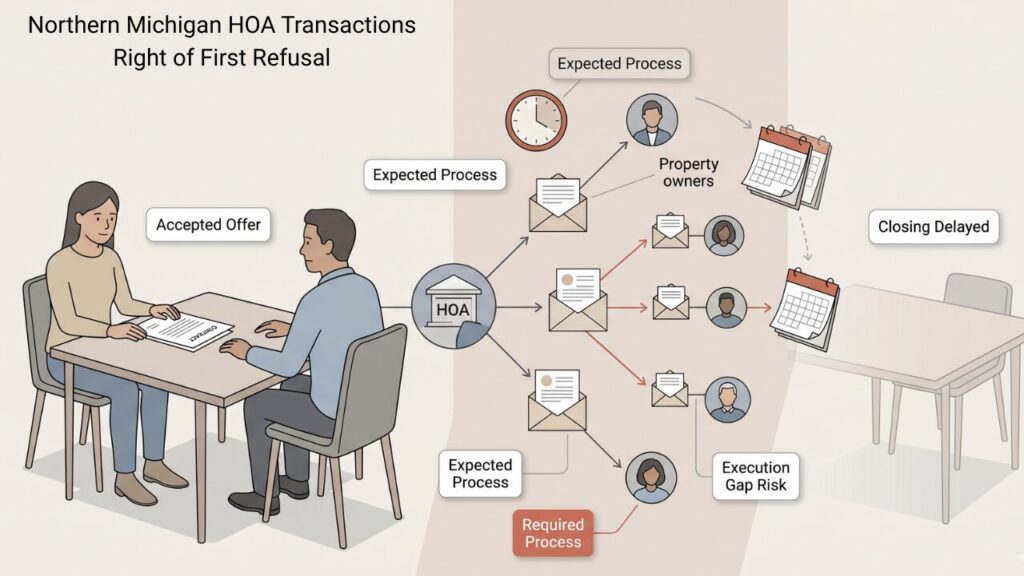
Execution Gap Risk is the difference between how a rule is expected to be carried out and how it must be executed to satisfy closing requirements.
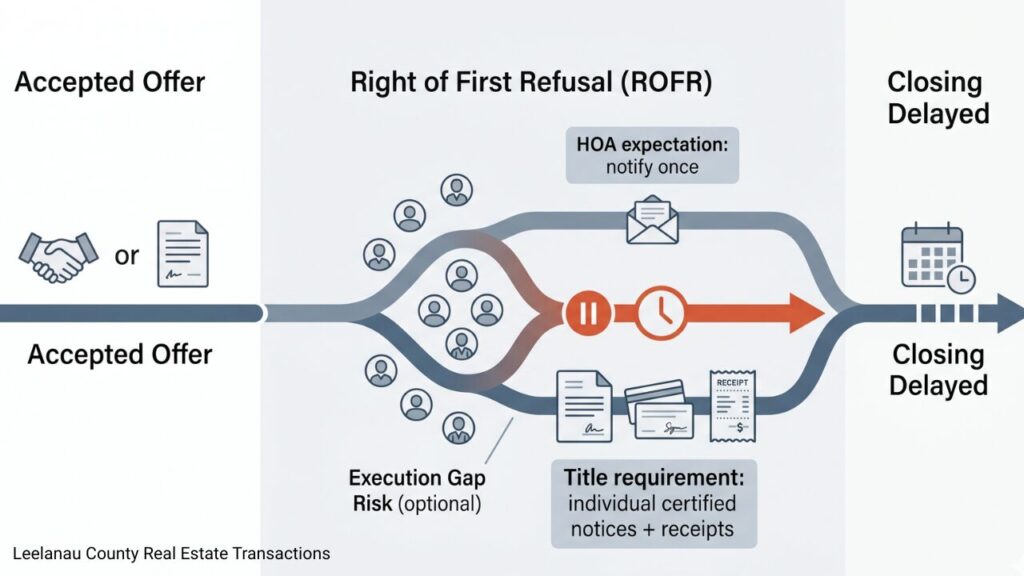
This gap most often appears when:
- HOA processes are informal
- Title companies require formal verification
- Documentation standards are not clearly defined
In areas like Leelanau Township, Northport, and other small Northern Michigan subdivisions, these informal processes are common due to long-term ownership patterns.
Right of First Refusal clauses are one of the most consistent triggers of this gap.
Execution Gap Risk is not unique to ROFR. It appears anywhere informal processes meet formal transaction requirements.
Common examples include:
- HOA approvals handled verbally but required in writing
- Historic practices that were never formally documented
- Assumptions about process that do not align with title or underwriting standards
Real-World Case: 45-Day Delay with No Change in Outcome
In a recent transaction in Leelanau County:
- The property was subject to a Right of First Refusal
- Ten separate property owners held the right
- No owner exercised the right
The transaction was delayed 45 days.
What Caused the Delay
The HOA had historically handled ROFR informally:
- Notify the HOA president
- The president notifies the membership
- No documented proof required
This process had worked in prior transfers.
Where the Process Broke
The title company required:
- Individual notice to each property owner
- Certified mail delivery
- Signed return receipts
Without this, title insurance would not be issued.
This requirement was introduced after the initial notice process had already been completed, forcing the process to restart under stricter standards.
Why This Matters
The delay was not caused by:
- Buyer hesitation
- Financing issues
- Inspection problems
It was caused entirely by verification requirements.
No party exercised the Right of First Refusal.
The outcome did not change.
Only the timeline expanded.
Decision Impact: How ROFR Changes Property Evaluation
A Right of First Refusal is not a neutral clause.
It changes how a property should be evaluated in three ways:
1. Timeline Risk
Closing timelines become dependent on third-party response and verification.
2. Buyer Pool Compression
Some buyers will opt out immediately when they see the clause.
3. Resale Friction
Future sale complexity increases, even if the clause is never exercised.
Observed Buyer Behavior
In this transaction:
- Multiple prospective buyers reviewed the HOA documents and declined to proceed
- No negotiation occurred
- The clause acted as an immediate filter
The eventual buyer:
- Was process-oriented
- Accepted the delay
- Viewed the clause as manageable
ROFR does not eliminate buyers.
It narrows them.
The remaining buyer pool is typically more process-oriented and less sensitive to timeline variability.
The Tradeoff Structure
Right of First Refusal clauses create a clear tradeoff.
Benefit
- Control over future ownership
- Early access to purchase opportunities
Cost
- Reduced liquidity
- Longer time to close
- Increased execution complexity
Most owners experience the benefit during ownership.
The cost appears at the time of sale.
Where Sellers Misinterpret the Risk
The clause often feels irrelevant while owning the property.
It becomes significant only when:
- A contract is in place
- A closing date is set
- A buyer is committed
At that point:
- Timeline flexibility is reduced
- Leverage is lower
- Delays carry real consequences
Interpretation Shift
An HOA may believe notifying one representative satisfies the requirement.
A title company may require documented proof of notice to every individual owner.
Both follow the same rule.
Only one satisfies closing requirements.
The Right of First Refusal clause itself does not delay a closing.
Enforcement does.
Failure Mode: Execution Gap Risk
This is a repeatable pattern.
Execution Gap Risk appears when:
- A process has historically been handled informally
- A third party requires formal documentation
- The requirement is introduced late in the transaction
Result:
- Process resets
- Timeline expands
- Stress increases
- Outcome remains unchanged
Checklist: Identifying ROFR Risk Before Listing
Before listing a property in an HOA, verify:
- Does a Right of First Refusal exist?
- Who holds the right?
- What is the required notice process?
- What proof will a title company require?
- How long does the process realistically take?
This should be confirmed before listing, not after a contract is accepted.
Northern Michigan Context
This pattern is common in areas with:
- Long-term ownership patterns
- Infrequent property transfers
- Informal governance practices
Right of First Refusal clauses are more common in:
- Small private subdivisions
- Agricultural or legacy land divisions
- Communities prioritizing ownership control
These structures are intentional.
They are not negative.
They are structurally different from open-market properties.
Final Position
Right of First Refusal clauses serve a purpose.
They control who enters a community.
They also affect how easily someone exits it.
Most sellers only experience this when they are already under contract.
Understanding how a property functions at the time of sale is as important as understanding how it functions during ownership.
ROFR is one example of how structural rules shape both sides of that equation.