
A guide to shared waterfront access, direct frontage, ownership fit, and real estate in Cherry Home Shores
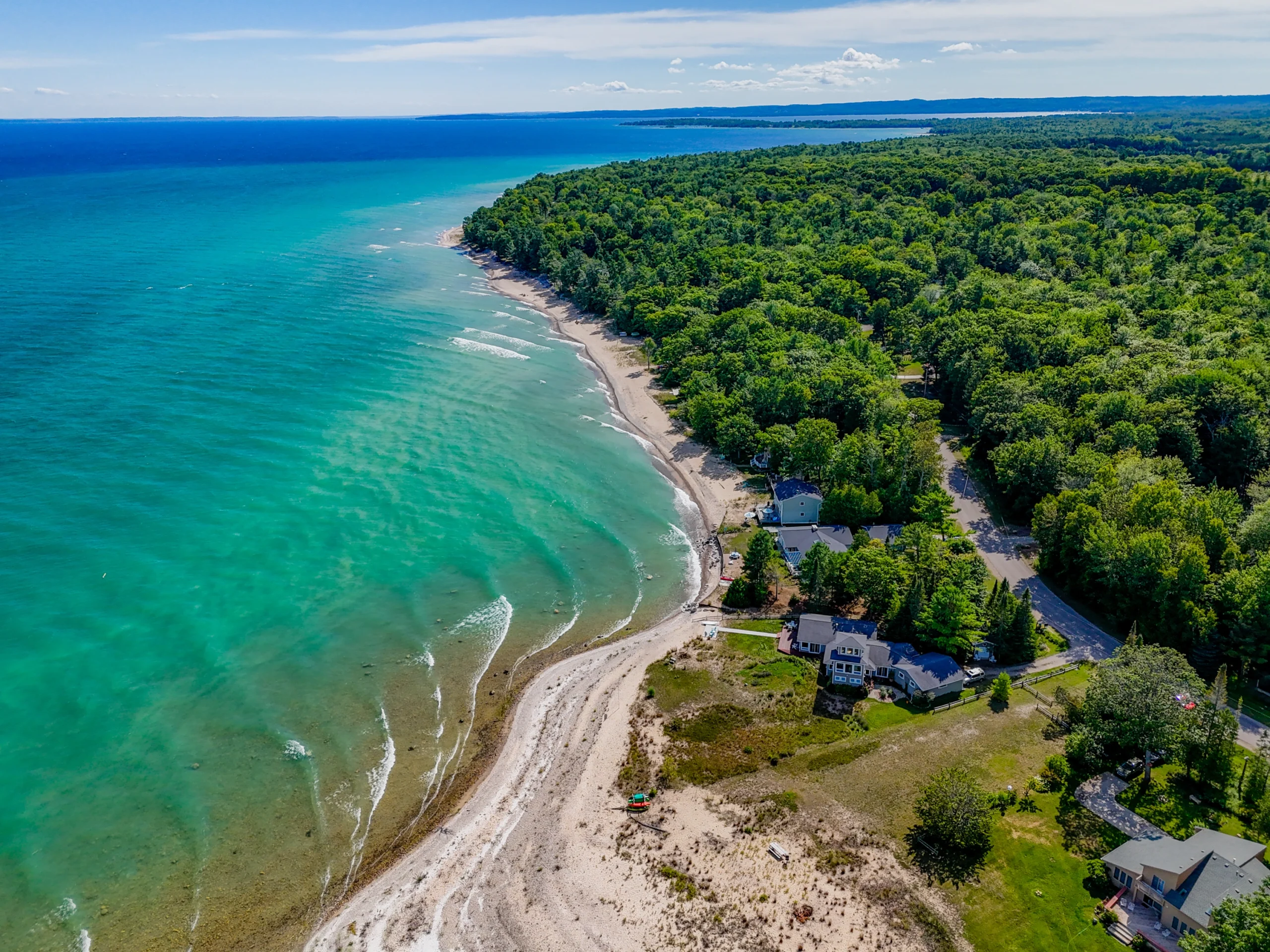
Cherry Home Shores is one of the better-known residential communities north of the Village of Northport. It offers a mix of private homes, wooded lots, direct waterfront properties, and Shared Waterfront Access to Lake Michigan’s Grand Traverse Bay.
But Cherry Home Shores is not a subdivision buyers should evaluate only from an MLS listing.
The ownership experience can change significantly depending on where a property sits, whether it has direct private frontage, how close it is to shared access, how the shoreline functions, how many lots are included, and what association rules apply.
Sander Scott helps buyers and sellers think through how Cherry Home Shores properties actually work, not just how they appear online.
What Cherry Home Shores Is
Cherry Home Shores is a deed-restricted residential community located near the tip of Michigan’s Leelanau Peninsula, about six miles north of the Village of Northport. The official Cherry Home Shores website describes the community as having homes and lots tucked in the woods or located on the water of Lake Michigan’s Grand Traverse Bay. It also describes Cherry Home Shores as a deed-restricted single-family residential community governed by the Cherry Home Association.
Cherry Home Shores is one example of why waterfront property in Northern Michigan should be evaluated through access, usability, restrictions, ownership structure, and long-term buyer fit. For the broader framework, start with Sander’s Northern Michigan Waterfront Property Guide.
That matters because Cherry Home Shores is not just a collection of private lots. It is a subdivision with common properties, shared amenities, deed restrictions, voting rights, dues, association governance, and rules that can affect how a property is used.
Some Cherry Home Shores properties have direct private waterfront. Others are interior or non-waterfront properties that benefit from Shared Waterfront Access through association parks and access points. Those two ownership patterns can both be valuable, but they are not the same thing.
A buyer looking at Cherry Home Shores should understand the difference between:
- owning direct private frontage
- having shared community access to the water
- having a water view
- being close to a shared access point
- owning multiple lots
- owning a home subject to association rules and deed restrictions
Those details affect value, usability, buyer fit, and future resale.
How Waterfront Access Works in Cherry Home Shores
One of the most important things to understand about Cherry Home Shores is that not every property has the same relationship to the water.
The official Cherry Home Shores general information page identifies four waterfront parks in the community: South Park, Clubhouse Park, Central Park, and North Park. Those parks are located along the waterfront on Forest Beach Shores and provide beach and lake access, along with picnic tables or benches and charcoal grills. The same page states that the parks are private amenities for CHA members/property owners, their families, and friends.
In addition to the park beaches, the Cherry Home Shores general information page also notes that there are several beach or water access points along Forest Beach Shores.
That is why the phrase Shared Waterfront Access matters.
Shared access can be a major benefit, especially for buyers who want recreational use of Grand Traverse Bay without paying for direct private frontage. But shared access is still different from direct frontage.
With shared access, buyers should think about:
- distance from the home to the access point
- parking or walking convenience
- shoreline character at that specific access
- beach usability
- kayak storage availability
- guest use rules
- privacy expectations
- association rules for common areas
With direct private frontage, buyers should think about a different set of issues:
- actual frontage width
- beach and bottom conditions
- bluff, slope, or walkability to the water
- privacy from neighbors and shared access points
- shoreline usability
- setback and building restrictions
- long-term maintenance
- how the property functions during different water levels
The mistake is treating “water access” and “waterfront” as interchangeable. They are related, but they create different ownership experiences.
Waterfront Character Across the Subdivision
This is part of the broader Waterfront Usability issue Sander explains in his Northern Michigan Waterfront Property Guide.
The waterfront in Cherry Home Shores is not identical from one part of the subdivision to another.
Based on Sander’s local observation, South Park is often thought of as one of the sandier shared access points in Cherry Home Shores. As you move north through the subdivision, some of the shared access areas can become more mixed, with more rock, stone, or variable shoreline conditions.
That same pattern can matter when evaluating private waterfront lots.
A property can look appealing in a photo and still function very differently in real life. A buyer should ask:
- Is the beach sandy, rocky, or mixed?
- Is the lake bottom comfortable for swimming?
- Is the water easy to access?
- Is there a bluff, slope, stairway, or erosion issue?
- Does the frontage feel private?
- Is the shoreline usable for the buyer’s actual lifestyle?
- Does the property offer easy daily use, or does the access create friction?
This is where Waterfront Usability becomes more important than appearance.
A listing photo may show blue water and shoreline. That does not tell the whole story. The real question is how the property functions when someone owns it.
For some buyers, shared access may be enough. For others, direct private frontage is the point of the purchase. For some, a sandy shared park nearby may matter more than having a rocky private shoreline. For others, privacy and direct frontage may outweigh the need for perfect sand.
The right answer depends on buyer fit.
Direct Waterfront vs Shared Waterfront
Cherry Home Shores includes more than one type of waterfront ownership experience.
Direct Private Waterfront
Direct private waterfront is structurally different from shared access. The owner has a more direct relationship between the home, land, and water.
That can mean:
- more privacy
- easier day-to-day use of the water
- stronger emotional connection to the shoreline
- greater scarcity
- more direct market value tied to frontage
- more responsibility for shoreline condition and maintenance
Direct waterfront also requires more careful due diligence. A buyer should look beyond the house and evaluate the land, beach, bottom, slope, setbacks, and long-term usability.
Wider frontage can also matter. A broader waterfront parcel may create a different feeling of privacy, view corridor, and long-term ownership flexibility than a narrower parcel.
Shared Waterfront Access
Shared Waterfront Access can be valuable for buyers who want access to Grand Traverse Bay but do not need to own direct private frontage.
That can mean:
- lower cost of entry than direct private waterfront
- access to association parks and lakefront areas
- less private control
- more dependence on common-area rules
- more importance placed on proximity to access points
- more need to understand association governance
Shared access works best when the buyer understands what they are buying. It is not a substitute for direct private frontage. It is a different ownership model.
Both can work. The key is matching the property to the buyer’s expectations.
Buyer Fit: Who Cherry Home Shores May Work Well For
Cherry Home Shores may be a good fit for buyers who want a Northport-area community with a defined residential structure, access to Grand Traverse Bay, and a setting that includes wooded lots, private homes, common amenities, and shared waterfront areas.
It may work especially well for:
- second-home buyers who want a Northport-area base
- retirees who want a residential community near the water
- family legacy buyers thinking long term
- buyers who value recreational water access
- buyers who like the idea of a community rather than isolated waterfront
- buyers who want access to Grand Traverse Bay without necessarily owning direct frontage
- buyers who understand that association rules are part of the ownership structure
Cherry Home Shores may be less suitable for buyers who want:
- short-term rental flexibility
- no association structure
- no deed restrictions
- purely isolated waterfront
- no common-area rules
- no architectural review process
- total freedom to build, rent, or modify without association review
This does not make Cherry Home Shores better or worse than other Northport-area options. It means the property needs to fit the buyer.
A buyer who wants quiet residential use, shared amenities, and access to the water may see a lot of value here. A buyer whose main goal is short-term rental income may need to slow down and review the restrictions carefully.
Rental and Use Restrictions
Rental use is one of the most important due diligence issues in Cherry Home Shores.
Cherry Home Association materials describe Cherry Home Shores as a residential single-family community, and the association’s public general information page states that, based on a previous court ruling, Cherry Home Shores does not allow commercial rentals of properties within the association. It also states that the ruling precludes advertising properties on online services or rental agencies, while permitting use of one’s residence by family or friends on an occasional or incidental basis.
The Residential Use Motion adopted by the Cherry Home Association addresses residential use, commercial renting, online rental advertising, and occasional renting or use by neighbors, colleagues, friends, and family members.
Sander understands that Cherry Home Shores does not permit rental terms shorter than 30 days. Buyers should still review the governing documents and confirm the current interpretation directly with the Cherry Home Association, the title company, and their own attorney before relying on any rental use.
This is not just a township issue.
A property can be located in Leelanau Township and still be subject to subdivision deed restrictions, association rules, and enforcement history. That is why buyers should not assume that municipal zoning tells the entire story.
For buyers considering any rental use, the key questions are:
- What do the deed restrictions say?
- What do the bylaws say?
- What does the Residential Use Motion say?
- What does the Cherry Home Association currently enforce?
- Is online advertising restricted?
- Are occasional family or friend uses treated differently?
- Does the buyer’s intended use fit the association’s rules?
- Has the buyer reviewed the documents with an attorney?
This page is informational only and is not legal advice.
Dues, Lots, and Ownership Structure
Cherry Home Shores dues are assessed on a per-lot basis.
The Cherry Home Association bylaws state that there is one vote per lot and that annual dues are assessed per originally platted lot. The bylaws also reference a dues amount of $64 per lot starting in 2022 and a process for future dues increases, including approval requirements.
Sander understands that annual dues are currently $75 per lot. A property with multiple lots may have higher total annual dues.
That is an important ownership detail. A buyer looking at Cherry Home Shores should not only ask, “What are the dues?” The better question is:
How many lots are included, and how does that affect dues, voting, use, frontage, building options, and future resale?
Multiple-lot ownership can affect more than annual cost. It can influence privacy, flexibility, frontage, value, and how the property compares to other Cherry Home Shores sales.
Buyers should confirm current dues, lot count, assessments, and association standing through current association documents, title work, seller disclosures, and closing documents.
Building, Renovation, and Architectural Review
Cherry Home Shores has an architectural review structure.
The Cherry Home Shores general information page states that before building or remodeling, owners must obtain approval from the CHA Architectural Committee and should make contact before starting to ensure plans are in accordance with the deed restrictions.
The Declaration of Deed Restrictions also contains architectural control language requiring plans and specifications to be submitted and approved before certain buildings, fences, walls, structures, exterior additions, changes, or alterations are made.
That does not mean every home in Cherry Home Shores looks the same. The subdivision includes a variety of home styles, ages, sizes, and settings. But buyers should understand that flexibility and review can exist at the same time.
A buyer planning to build, remodel, add an outbuilding, change an exterior, remove trees, or materially change a property should review the documents early.
The mistake is waiting until after an accepted offer to ask whether the buyer’s future plan fits.
This is especially important for:
- vacant lots
- older cottages
- additions
- garage or outbuilding plans
- exterior renovation plans
- tree removal
- shoreline-related improvements
- buyers assuming future rental or guest-use flexibility
Association review does not automatically mean a plan will fail. It means the plan needs to be evaluated in the context of the subdivision’s rules.
Market Behavior in Cherry Home Shores
Cherry Home Shores does not behave like a generic subdivision.
Value is shaped by more than bedrooms, bathrooms, and square footage. In this community, market behavior is influenced by:
- direct waterfront versus shared access
- frontage width
- shoreline character
- beach usability
- proximity to shared parks
- lot count
- privacy
- age and condition of the cottage or home
- association rules
- rental limitations
- buyer expectations
- long-term ownership fit
Shared waterfront communities tend to attract a specific buyer pool. These buyers often value access, setting, community, and long-term use more than they value short-term rental income or maximum flexibility.
Direct waterfront inventory is more limited. When a direct waterfront property becomes available, buyers often focus heavily on the land and shoreline, not just the structure.
That is why a rustic cottage can still carry meaningful value. In a waterfront community, the house may be only one part of the value. The land, frontage, water relationship, privacy, and future use may matter just as much, or more.
Price per square foot can be misleading in Cherry Home Shores.
A smaller cottage with better frontage may be more valuable than a larger home with less usable access. A property with multiple lots may function differently than a single-lot home. A home near one shared access point may appeal differently than a home farther from the water.
The right question is not only, “What is the house worth?”
The better question is:
How does this property function inside Cherry Home Shores?
Sander’s Experience in Cherry Home Shores
Sander Scott has represented multiple properties in Cherry Home Shores.
That experience matters because Cherry Home Shores is not a community buyers should evaluate only from listing fields.
Sander’s prior non-waterfront listings helped build subdivision-specific knowledge around access, association structure, buyer response, pricing, and the difference between shared-access ownership and other Northport-area property types.
A neighborhood open house also reinforced something that does not always show up in a listing description: Cherry Home Shores has a real community character. Buyers are not only evaluating a structure or a lot. They are evaluating how ownership feels inside a specific residential setting.
That does not mean Cherry Home Shores is the right fit for every buyer. It means the fit should be evaluated carefully.
Sander’s role is to help buyers and sellers understand the property in context.
Common Buyer Misunderstandings About Cherry Home Shores
1. Assuming all shared waterfront access is the same
Shared access points can differ in location, shoreline character, convenience, and usability. A buyer should not assume that one access point represents all of Cherry Home Shores.
2. Assuming water access equals waterfront usability
Water access has value, but usability depends on distance, shoreline conditions, rules, privacy, and how the buyer actually plans to use the property.
3. Overlooking rental restrictions
Rental restrictions can change the buyer pool and the ownership plan. Buyers interested in rental use should review the governing documents before assuming a property will work for that purpose.
4. Misunderstanding association review
Architectural review does not necessarily prevent improvements, but it does mean buyers should understand the process before planning construction, remodeling, or exterior changes.
5. Focusing only on cottage condition
In Cherry Home Shores, land, lot count, frontage, shared access, shoreline usability, and long-term use may matter as much as the structure.
6. Ignoring the difference between direct frontage and shared access
Direct frontage and Shared Waterfront Access are not the same ownership model. Both can be valuable, but they serve different buyer goals.
7. Treating HOA dues as a single number without checking lot count
Because dues are assessed per lot, a property with multiple lots may have a higher annual dues amount than a single-lot property.
8. Assuming township rules answer every use question
Township rules are only part of the analysis. Deed restrictions, association rules, and enforcement history may also matter.
Official Cherry Home Shores Documents to Review
Buyers should review the current Cherry Home Association documents before relying on any planned use of a property.
The Cherry Home Shores documents page publicly lists governing documents, including Articles of Incorporation, Deed Restrictions, By-Laws, and Residential Use of Land and Buildings in CHA. It also lists maps and other documents, including the CHA Plat Map, CHA Platted Aerial Map, Walking Trails Map, Member Info Sheet, Clubhouse Rental Guidelines, Kayak Storage Waiver, and CHA Rules.
Important documents may include:
- Articles of Incorporation
- Declaration of Deed Restrictions
- Bylaws
- Residential Use of Land and Buildings in CHA
- CHA Rules and Regulations
- Plat maps
- Aerial maps
- Kayak storage documents
- Clubhouse rules
- Any current association communications about dues, assessments, use, or rule changes
This page is informational only. It is not legal advice. Buyers should confirm current rules directly with the Cherry Home Association, title company, and their own attorney before purchasing.
Related Resources
Cherry Home Shores is one example of why waterfront ownership in Northern Michigan requires more than a basic listing search.
These related resources can help buyers and sellers understand the broader issues:
Northern Michigan Waterfront Property Guide
Start here if you are comparing waterfront properties across Leelanau County, Grand Traverse County, Benzie County, and the broader Northern Michigan market.
Read Northern Michigan Waterfront Property Guide
Waterfront Usability
Waterfront usability is the difference between a property that looks good in photos and a property that actually works for the way the owner wants to use the water.
Dockable Shoreline
Dockability can affect how a buyer evaluates waterfront property, especially when boating, water depth, shoreline regulations, and lake conditions matter.
Protected Water
Protected water can create a different ownership experience than exposed big-water frontage. Buyers should understand how wind, waves, exposure, and location affect use.
Access Friction
Access friction describes the hidden difficulty between owning a property and actually using the feature that made the property attractive in the first place.
Waterfront Supply Constraints
Waterfront property is limited by geography, ownership patterns, regulation, and long-term holding behavior. That can affect both buyer competition and seller value.
Read Waterfront Supply Constraints
Shared Waterfront Access
Shared Waterfront Access means a property owner has access to waterfront through a shared association, easement, park, road end, or common area rather than owning direct private frontage as part of the individual parcel.
Living in Northport, Michigan
Cherry Home Shores is part of the broader Northport-area lifestyle and real estate market.
Read Living in Northport, Michigan
Growing Up On the Water
Sander’s personal background growing up on Northport Bay shapes how he evaluates waterfront property, beach quality, access, and long-term ownership fit.
Real Estate Authority Glossary
Use the glossary to better understand terms like waterfront usability, access friction, ownership patterns, and other frameworks that help explain property value.
Read Real Estate Authority Glossary
Frequently Asked Questions About Cherry Home Shores
Talk Through a Cherry Home Shores Property
If you are evaluating a property in Cherry Home Shores or thinking about selling in the subdivision, Sander Scott can help you think through how the property actually functions.
That means looking beyond bedrooms, bathrooms, and square footage.
It means evaluating:
- direct waterfront versus Shared Waterfront Access
- beach and shoreline usability
- lot count
- dues
- association rules
- rental restrictions
- buyer fit
- future resale
- how the property compares inside the subdivision
Cherry Home Shores can be a strong fit for the right buyer. The key is understanding what kind of ownership experience the property actually offers.