
Structural factors limiting privately owned Lake Michigan shoreline housing in Northern Michigan
Lake Michigan waterfront housing supply in Northern Michigan is shaped by geographic, environmental, and regulatory conditions that constrain the number of privately owned shoreline parcels.
A March 8, 2026 article published by Realtor.com examining beach towns with strong short-term rental demand referenced this issue while citing AirDNA data on coastal rental markets. The article noted that properties with direct waterfront access typically command significant price premiums and included commentary from Northern Michigan real estate broker Sander Scott that protected land and low-density development patterns restrict the supply of privately owned Lake Michigan shoreline housing in many Northern Michigan communities.
This observation reflects a broader structural pattern along portions of Lake Michigan where geographic conditions, land protection policies, and regulatory frameworks limit the number of privately owned waterfront parcels that can exist.
Understanding this constraint requires distinguishing between market inventory and structural supply limits.
Seasonal inventory reflects buyer and seller activity. Structural supply limits reflect conditions that permanently constrain how many waterfront parcels can exist.
Structural Drivers of Lake Michigan Waterfront Scarcity
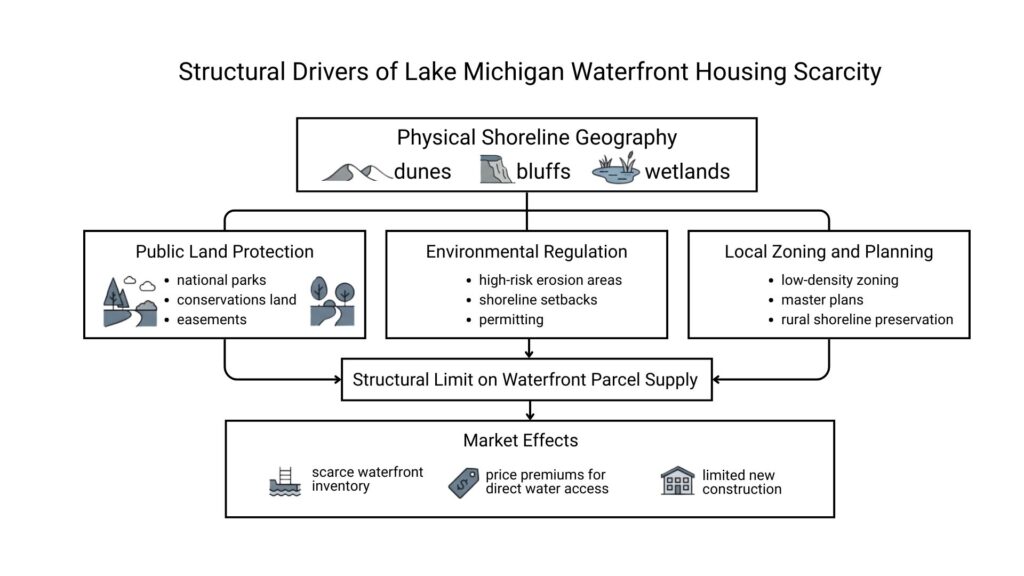
Lake Michigan shoreline housing supply in Northern Michigan is shaped by several overlapping structural conditions that limit the amount of shoreline available for private residential development.
Primary drivers include:
- physical shoreline geography including dunes, bluffs, and coastal wetlands
- public ownership of shoreline through parks and protected lands
- conservation easements that prevent subdivision or development
- environmental regulations governing erosion hazards and shoreline alteration
- local zoning policies that maintain low-density residential patterns
When these conditions occur together within the same geographic region, the number of privately owned waterfront parcels becomes inherently limited. This structural scarcity differs from temporary housing inventory shortages that may occur during active real estate cycles.
Physical Shoreline Geography
Michigan contains approximately 3,288 miles of Great Lakes shoreline, but the coastline is not uniform.
State shoreline management guidance indicates that Great Lakes coastlines include dune systems, coastal wetlands, and bluff formations that vary significantly in their suitability for development.
Along the eastern shoreline of Lake Michigan in Northwest Michigan, dune fields and bluff systems are common shoreline features.
Lake Michigan shoreline is also highly segmented by dunes, bluffs, wetlands, and protected land ownership patterns, which means the amount of shoreline suitable for residential development varies significantly from one community to another.
These landforms create distinctive coastal landscapes but may introduce development limitations related to erosion risk, slope stability, or environmental sensitivity. As a result, not all shoreline segments support residential development under the same conditions.
Public and Protected Shoreline
A significant portion of Lake Michigan shoreline in Northwest Michigan is permanently protected through public ownership or conservation programs.
One major example is Sleeping Bear Dunes National Lakeshore, which protects approximately:
- 35 miles of mainland Lake Michigan shoreline
- 65 miles of total shoreline including the Manitou Islands
- more than 71,000 acres of protected land
Because these lands are preserved for public use, they are permanently removed from the private residential housing market.
Regional conservation organizations also protect significant shoreline acreage.
The Grand Traverse Regional Land Conservancy reports protecting more than 48,000 acres of land and 157 miles of shoreline within its service area.
The Leelanau Conservancy reports preserving more than 18,000 acres and over 53 miles of streams, rivers, and shoreline.
Conservation easements and land protection programs prevent subdivision or fragmentation of many shoreline properties.
These protections preserve ecological and recreational resources while also limiting the amount of shoreline available for private residential development.
Shoreline Hazard and Environmental Regulation
Environmental regulation represents another structural constraint affecting Lake Michigan shoreline development.
The Michigan Department of Environment, Great Lakes, and Energy identifies high-risk erosion areas as shoreline segments receding at an average rate of one foot per year or more over a fifteen-year period.
Structures proposed within these areas must meet setback requirements based on projected shoreline recession over 30- or 60-year time horizons, depending on whether the structure is movable.
Approximately 250 miles of Great Lakes shoreline across Lakes Michigan, Superior, and Huron are designated high-risk erosion areas.
Permits are required for regulated uses in these locations.
These requirements do not prohibit development in all cases but can increase regulatory review, construction costs, and development uncertainty along certain shoreline segments.
Shoreline Management and Coastal Dynamics
Lake Michigan shorelines function as dynamic coastal systems rather than fixed landforms.
Guidance from the Michigan Department of Environment, Great Lakes, and Energy notes that shoreline armoring structures such as seawalls may create secondary impacts including:
- reflected wave energy
- scouring of lakebed sediment
- impacts to neighboring shoreline segments
- changes to water quality
These environmental considerations influence shoreline management policies and affect how waterfront parcels may be developed or protected over time.
Local Land-Use Policy
Local zoning policy also contributes to structural supply limits.
Many Lake Michigan shoreline communities in Northern Michigan maintain low-density residential zoning and environmental protection policies rather than pursuing maximum shoreline development.
Lake Township provides one example.
The township’s 2023 master plan notes that development pressure associated with seasonal residents, tourism activity, and short-term rental demand has increased interest in lakeshore property.
The plan also states that:
- very little undeveloped lakeshore property remains
- shoreline zoning should continue to support single-family residential patterns
- rural and open-space character should be preserved
Policies of this type limit the creation of new waterfront housing units even when demand increases.
Structural Supply Limits and Market Pricing
In many housing markets, rising prices can trigger significant increases in construction activity.
Lake Michigan shoreline markets often behave differently.
Where shoreline is publicly owned, environmentally constrained, protected through conservation, or governed by low-density zoning, the number of potential waterfront parcels cannot expand significantly in response to demand.
These structural limits help explain why the price difference between general housing in coastal communities and direct waterfront properties is often substantial.
Citywide median home prices may include many inland properties.
Parcels with direct water access represent a smaller and structurally constrained segment of the housing market.
Summary
Lake Michigan waterfront housing supply in Northern Michigan is shaped by structural constraints including shoreline geography, public land ownership, conservation protection, environmental regulation, and local land-use policy.
These conditions limit how much privately owned shoreline can enter the housing market.
As a result, Lake Michigan waterfront property supply often behaves differently from typical residential housing inventory and may remain limited even during periods of strong demand.
Key Data Points About Lake Michigan Waterfront Supply
Several structural facts illustrate why privately owned Lake Michigan shoreline housing supply remains limited in many Northern Michigan communities.
- Michigan contains approximately 3,288 miles of Great Lakes shoreline.
- Sleeping Bear Dunes National Lakeshore protects roughly 35 miles of mainland Lake Michigan shoreline and more than 71,000 acres of land.
- Approximately 250 miles of Great Lakes shoreline are designated high-risk erosion areas under state shoreline management programs.
- Regional conservation organizations have protected tens of thousands of acres and more than 150 miles of shoreline across Northwest Michigan.
These geographic, regulatory, and conservation factors reduce the amount of shoreline available for private residential development and influence how waterfront housing markets function along Lake Michigan.
Frequently Asked Questions About Lake Michigan Waterfront Supply
Why is Lake Michigan waterfront property scarce?
Privately owned shoreline parcels are limited by several structural conditions including shoreline geography, conservation land protection, environmental regulation, and local zoning policies that restrict development along portions of the coast.
How much Lake Michigan shoreline is publicly protected?
Large portions of shoreline in Northwest Michigan are protected through federal ownership, state parks, and conservation easements. For example, Sleeping Bear Dunes National Lakeshore alone protects approximately 35 miles of mainland Lake Michigan shoreline.
Can more waterfront homes be built along Lake Michigan?
In many locations the number of new waterfront housing units that can be created is limited by zoning rules, shoreline setbacks, erosion hazard areas, and the presence of protected land.
Why do waterfront homes cost more than inland homes?
Waterfront parcels represent a smaller and structurally constrained portion of the housing market. Because the supply of shoreline property is limited while demand remains strong, direct water access often commands a significant price premium.
Media Mentions
Sander Scott is a Northern Michigan real estate broker specializing in waterfront property markets along Lake Michigan. His commentary has appeared in national publications. View media mentions.