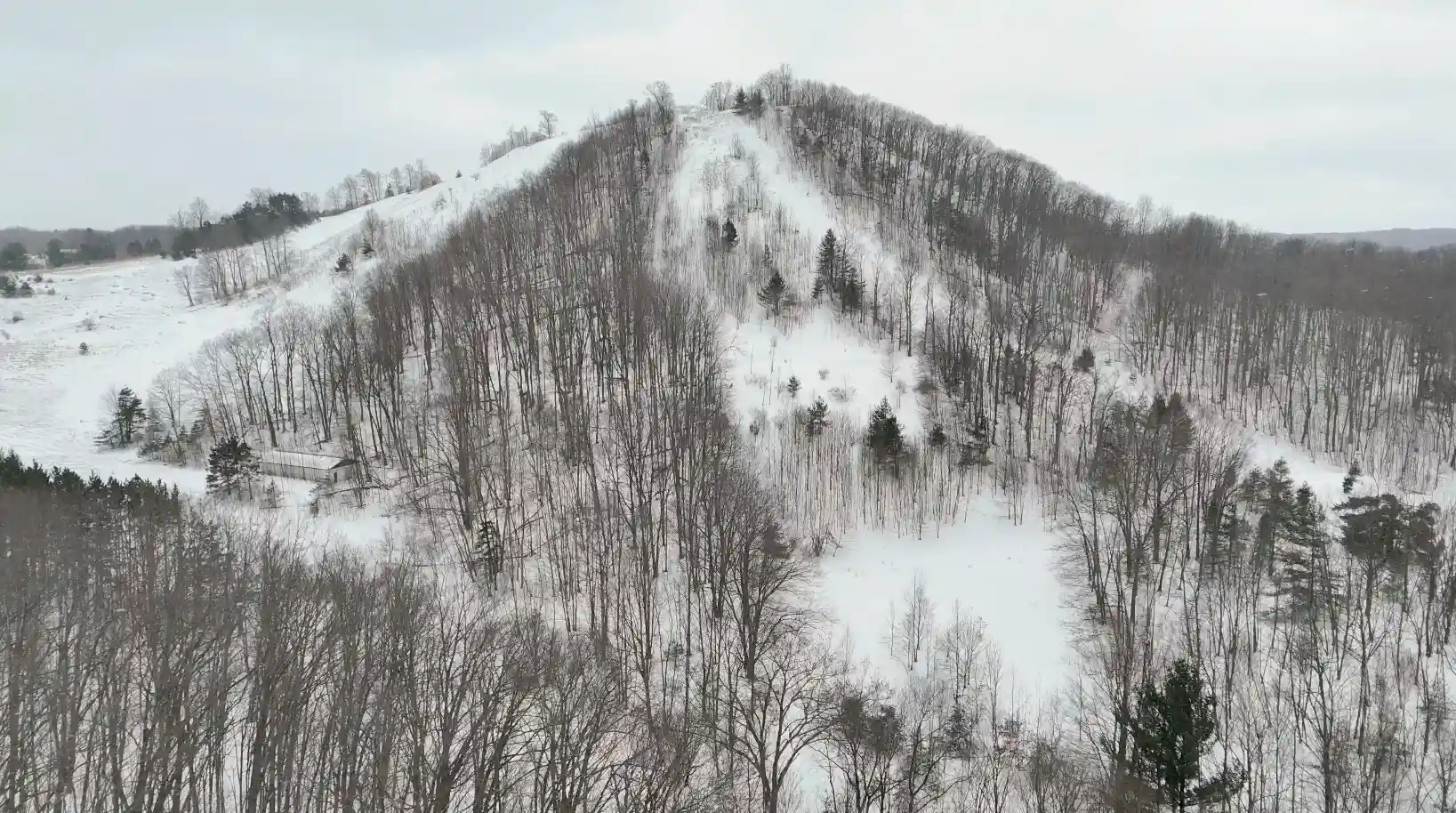
For many years, Sugar Loaf Mountain occupied an uncertain position within Leelanau County. While the site held strong emotional and historical significance, the lack of clarity around its future introduced hesitation in how nearby properties were evaluated.
The transition from an abandoned private site to protected public land marked a change in how the area is understood. This article describes observed patterns in how that shift has influenced perception of surrounding areas, focusing on land use context and long-term certainty rather than prediction or recommendation.
Jump to Section
TL;DR — Key Takeaways
- Sugar Loaf’s transition from private uncertainty to protected public land reduced long-standing questions about future use.
- Preserved land is commonly associated with clearer expectations around surrounding development.
- Access to four-season recreation influences how nearby properties are evaluated beyond summer use.
- The influence of conservation projects often extends beyond immediately adjacent parcels.
- Market response to preservation tends to be gradual and shaped by awareness rather than sudden change.
Why Sugar Loaf’s Land Transition Matters
Real estate markets often respond to changes in certainty. When land with an unclear future becomes permanently preserved, questions about potential development, congestion, or commercial use are reduced.
In the case of Sugar Loaf, preservation replaced prolonged ambiguity with defined stewardship. Observed discussions indicate that this clarity affects how surrounding areas are considered in terms of long-term surroundings and compatibility with the broader character of Leelanau County.
Patterns suggest that certainty itself plays a role in shaping confidence, independent of specific amenities.
From Uncertainty to Permanence
Prior to preservation, Sugar Loaf was associated with a wide range of possible outcomes, including redevelopment or continued vacancy. These unknowns frequently appeared in conversations about nearby properties.
As the land moved toward permanent conservation and public access, speculative concerns diminished. The shift reduced the range of future scenarios considered and altered the assumptions applied to nearby areas.
This change did not produce immediate market movement, but it influenced how properties were contextualized over time.
How Access to Preserved Land Influences Perception
Property evaluation often includes consideration of surrounding land use. Preserved land is commonly associated with stability and continuity, signaling that viewsheds, trails, and open space are likely to remain unchanged.
In Northern Michigan, where lifestyle and environmental context are significant factors, access to non-commercial outdoor space carries meaning beyond recreation alone. Observed patterns indicate that proximity to protected land is often interpreted positively, even when properties are not directly adjacent.
Outdoor Recreation and Year-Round Use
Sugar Loaf’s preservation emphasizes four-season, low-impact recreation, including hiking, biking, snowshoeing, and Nordic skiing.
Properties associated with year-round outdoor access are often viewed differently than those tied primarily to summer use. Evaluation frequently considers how a location fits into daily routines across seasons rather than only during peak periods.
This broader usability appears to support steady interest rather than sharp seasonal spikes.
Connections to Nearby Inland and Waterfront Properties
The influence of preserved land extends beyond immediately neighboring parcels. Inland properties, village homes, and waterfront areas are affected indirectly through overall landscape quality.
In particular, waterfront areas are often evaluated in relation to what exists beyond the shoreline. Preserved acreage contributes to a sense of environmental continuity, which shapes perception even when the property itself is water-oriented.
Sugar Loaf’s integration into a wider network of preserved land reinforces this continuity across Leelanau County.
How Preserved Land Shapes Local Market Behavior
Conservation projects tend to influence markets gradually. Awareness often spreads through local knowledge, visible access points, trail use, and community activity rather than through formal announcements.
Observed patterns suggest that interest increases as preservation becomes tangible. Trailheads, parking areas, and visible improvements make conservation more concrete.
This process typically results in measured shifts rather than sudden changes in activity or value.
Observed Timing and Awareness Patterns
Market response to preservation does not occur all at once. Early awareness often comes from local residents and frequent visitors, with broader recognition following as access improves and information circulates.
Seasonal use highlights different aspects of preserved land. Winter activity demonstrates year-round relevance, while summer visibility brings broader attention. These cycles shape how the change is encountered and understood over time.
Frequently Asked Questions
What changed at Sugar Loaf?
The land transitioned from private ownership with uncertain future use to protected public land focused on conservation and recreation.
Does preserved land affect nearby property values?
Historically, proximity to protected land has been associated with steadier confidence, though effects vary by location and property type.
Is Sugar Loaf being redeveloped commercially?
No. Current plans emphasize conservation and public access rather than commercial resort development.
Does Sugar Loaf influence waterfront properties?
Indirectly. Preserved landscapes contribute to overall place quality, which affects perception of nearby inland and waterfront areas.
Is Sugar Loaf being redeveloped commercially?
No. Current plans emphasize conservation and public access rather than commercial resort development.
Does Sugar Loaf influence waterfront properties?
Indirectly. Preserved landscapes contribute to overall place quality, which affects perception of nearby inland and waterfront areas.
Are market effects immediate?
Observed effects tend to emerge gradually as awareness and access increase.
Summary of Observations
Sugar Loaf’s preservation represents a shift from uncertainty to permanence within Leelanau County. This change influences how surrounding areas are perceived through time, primarily by reducing unknowns and clarifying long-term land use.
The patterns described here are provided as contextual reference material. They illustrate how conservation, access, and certainty interact with real estate perception without directing outcomes or decisions.